


Each cello is unique and begins with the choice of wood
A cello essentially consists of three types of wood
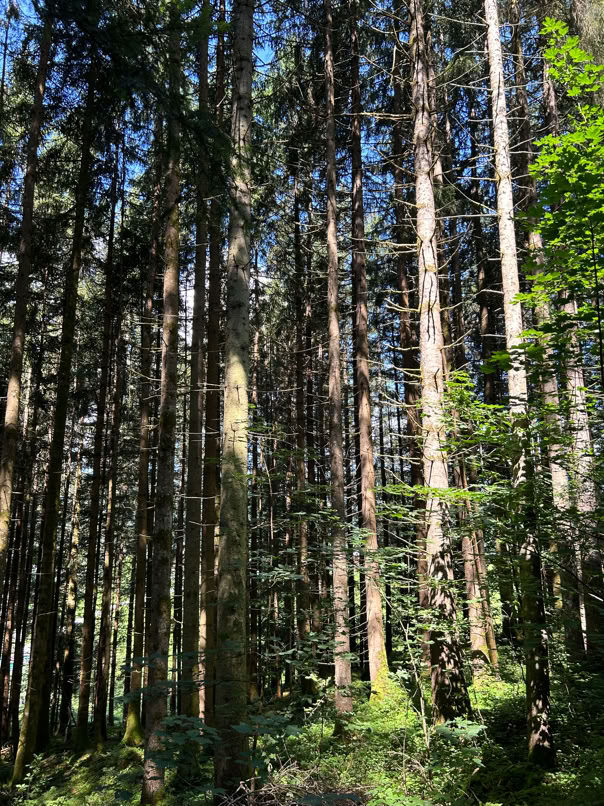
Spruce (Picea abies var. abies): Belly (top plate), corner blocks, upper block, lower block, linings, bass bar, sound post
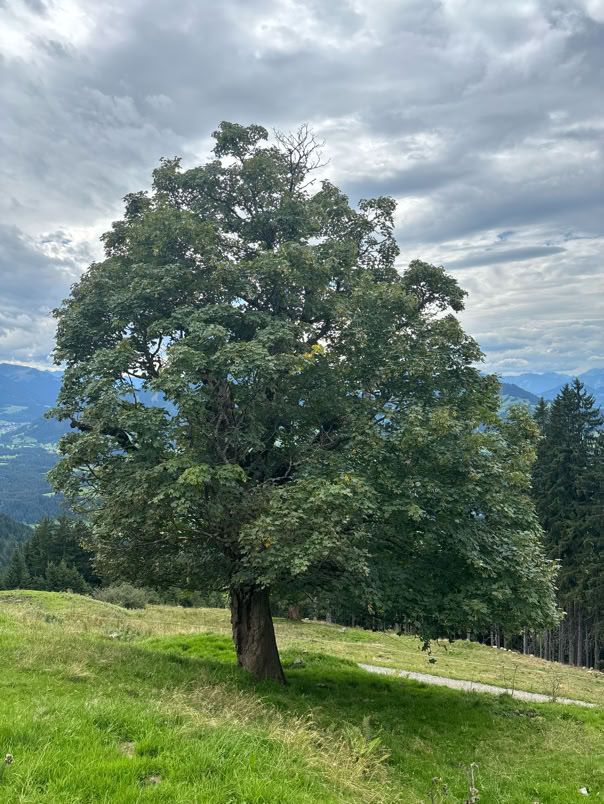
Maple (Acer pseudoplatanus): Ribs, back, neck with pegbox and scroll, bridge, purfling (inner layer),
Ebony (Diospyros spp.): Pegs, fingerboard, tailpiece, upper and lower nut, purfling (outer layers)
Alternatively, Black poplar (Populus nigra) or Willow (Salix spp.) are also used for the corner, upper and lower blocks, linings and inner layer of the purfling.
Spruce (Picea abies var. abies), Tiger spruce
Spruce is particularly suitable for making the belly. Information on the physical properties varies greatly. Spruce usually has an average density of 0.46 g/cm3 (12% moisture content, FG), whereby a density of approx. 0.39-0.41 g/cm3 is preferable.
Tensile, compressive and flexural strengths are specified as 95, 45 and 80 N/mm2 (LWF Wissen 80). In addition to visual and aesthetic aspects, the distribution of the late and early wood has a significant influence on the vibration properties. The distance between the late wood parts of the cello should generally not be much more than 4 mm and should be as even and parallel as possible. However, when comparing old Cremonese celli of similar quality, very large differences can be observed. The physical parameters such as moisture, density and conduction velocity can be measured objectively, but ultimately the decisive factor in choosing the optimum tonewood is the individual sound impression when tapping.
Sycamore maple (Acer pseudoplatanus), Figured maple, Bird´s eye maple (specific type of Sugar maple, Acer saccharum)
The sycamore maple is the preferred tonewood for the ribs and back and is also often used in the special, presumably genetically determined but rare (up to approx. 7%) curly growth form (Figured or Curly maple) (Quambusch et al., 2021). Occasionally, bird's eye maple (specific type of Sugar maple) is also used as a rind cut due to its special appearance (Bragg & Stokke, 1994). Sycamore maple is also used to make the scroll, pegbox and neck. The physical properties of maple also vary considerably. Sycamore has a density (g/cm3) of 0.51-0.64 (dried), 0.52-0.73 (12% moisture content) and 1.00-1.16 (raw wood) (Tomislav et al., 2017). The compressive strengths (N/mm2) are in the ranges 37.4-52.8 (longitudinal), 9.4-19.8 (radial) and 7.4-14.4 (tangential). The bending strength is 69.0-110 N/mm2. The Brinell hardnesses (N/mm2) are given as 41.5-61.7 (0° fiber angle) and 21.8-43.4 (90° fiber angle).
Ebony (Diospyros spp.)
The parts of the cello that are subject to particularly heavy use (pegs, nut, fingerboard, tailpiece) are usually made of ebony. As some ebony species are protected by the CITES Convention on International Trade in Endangered Species of Wild Fauna and Flora (see BfN), some parts are now also made of plastic (pegs, tailpiece) or alternative materials (e.g. Ebonprex). Ebony has a very high density of 1.1-1.3 g/cm3 (green wood) and 1.1-1.2 g/cm3 (12% moisture content). The compressive strength is given as 76 N/mm2 on average and the bending strength as 158 N/mm2 (Liu et al., 2020).
The basic properties of wood include its hemicellulose, cellulose and lignin content, specific weight (degree of dryness), ratio of earlywood to latewood, relative moisture content and the bending, tensile and compressive strength resulting from these components. Hemicellulose and cellulose are polysaccharides, while lignin is a phenolic macromolecule.
Hemicellulose and cellulose
Hemicelluloses and cellulose are polysaccharides and form part of the plant cell wall (Scheller and Ulskov, 2010). Hemicelluloses contribute significantly to the strengthening of the cell wall, primarily through their cross-linking with cellulose and, in some cell walls, also with lignin. Hemicelluloses and cellulose can be hydrolysed by alkaline treatment (e.g. NaOH, KOH, NH3) (Alvarez-Vasco and Zhang, 2013; Knill and Kennedy, 2003). Recent studies have shown that the acoustic properties of tonewoods can be significantly improved by heat treatment (250°C, 1h) in combination with fungal treatment, e.g. with the common split gill fungus (Schizophyllum commune) (Nefdt and Meincken, 2024). This treatment reduces the proportion of hemicellulose without causing a greater degradation of cellulose. This leads to a reduction in density while maintaining elasticity (MOEL) and thus to an increase in the acoustically important radiation ratio (R).
Lignin
Lignin is a complex three-dimensional biopolymer consisting of highly heterogeneous phenolic monomers (monolignols) (Ralph et al., 2019). During lignification, the monolignols undergo polymerisation and are incorporated into the cell wall. Lignin contributes significantly to the stability and compressive strength of wood.
References
Alvarez-Vasco C, Zhang X. Alkaline hydrogen peroxide pretreatment of softwood: Hemicellulose degradation pathways. Bioresource Technology. 2013; 150:321-327. https://doi.org/10.1016/j.biortech.2013.10.020.
Bragg DC, Stokke DD. Field identification of birdseye in sugar maple (Acer saccharum Marsh.). Research Paper NC-317. 1994; St. Paul, MN: U.S. Dept. of Agriculture, Forest Service, North Central Forest Experiment Station
Gurău L, Timar MC, Coșereanu C, Cosnita M, Stanciu MD. Aging of Wood for Musical Instruments: Analysis of Changes in Color, Surface Morphology, Chemical, and Physical-Acoustical Properties during UV and Thermal Exposure. Polymers (Basel). 2023;15:1794. doi: 10.3390/polym15071794. PMID: 37050408; PMCID: PMC10097407.
Knill CJ, Kennedy JF. Degradation of cellulose under alkaline conditions. Carbohydrate Polymers. 2003;51:281-300. https://doi.org/10.1016/S0144-8617(02)00183-2
Kučerová V, Hrčka R, Hýrošová T. Relation of Chemical Composition and Colour of Spruce Wood. Polymers. 2022; 14(23):5333. https://doi.org/10.3390/polym14235333
Latif A, Shuhaida H, Mohd Shaiful S, Masturah M, Jahim JM. Ammonia-based pretreatment for ligno-cellulosic biomass conversion – an overview. Journal of Engineering Science and Technology. 2018;13:1595-1620.
Liu M, Peng L, Lyu S, Lyu J. Properties of common tropical hardwoods for fretboard of string instruments. Journal of Wood Science. 2020; 66, 14. https://doi.org/10.1186/s10086-020-01862-7
LWF Wissen 80. Beiträge zur Fichte. Bayerische Landesanstalt für Wald und Forstwirtschaft. 2017, Bosch-Druck GmbH, Ergolding, ISSN 2198-106X
Nefdt K, Meincken M. Modifying the radiation ratio of tonewoods through wood degradation. Wood Material Science & Engineering. 2024;1–8. https://doi.org/10.1080/17480272.2024.2376858
Quambusch M, Bäucker C, Haag V, Meier-Dinkel A, Liesebach A. Growth performance and wood structure of wavy grain sycamore maple (Acer pseudoplatanus L.) in a progeny trial. Annals of Forest Science. 2021; 78, 15. https://doi.org/10.1007/s13595-021-01035-6
Ralph J, Lapierre C, Boerjan W. Lignin structure and its engineering. Curr Opin Biotechnol. 2019 Apr;56:240-249. doi: 10.1016/j.copbio.2019.02.019. Epub 2019 Mar 25. PMID: 30921563.
Scheller HV, Ulvskov P. Hemicelluloses. Annu Rev Plant Biol. 2010;61:263-89. doi: 10.1146/annurev-arplant-042809-112315. PMID: 20192742.
Tomislav S, Bogoslav S, Srdan S, Tomislav S. Wood Quality Characterization of Sycamore Maple (Acer pseudoplatanus L.) and its Utilization in Wood Products Industries. Croatian Journal of Forest Engineering. 2017; 42(3):543. https://doi.org/10.5552/crojfe.2021.1099